
Updated September 29, 2026

Devlog

What's actually being built, in the order it happens. Written up when there's honest progress to report.

September 29, 2026Movement

Every Bench a Step

Movement leaves the test room for a real village, and a humble bench against a wall changes how the whole world is read.

Until now every leap and climb was tried in a bare room of grey blocks. This week movement was lifted out and set down in a separate project, built the way the finished game will be built, in a real village: dry-stone walls, cottage roofs, benches, hay, and uneven ground. It is borrowed scenery, a ready-made village used as a proving ground, not Thessyra's own art. The point was to find what the grey room never could.

The body walking it is new too: a MetaHuman, Epic's realistic human, worn over the stand-in skeleton the movement is built on. It is the first time Thessyra has been seen as a person rather than a grey mannequin, and it shows the realism the world is reaching for. It is still a stand-in. How Thessyra's five peoples are finally made, dwarves and halflings included, is yet to be settled.
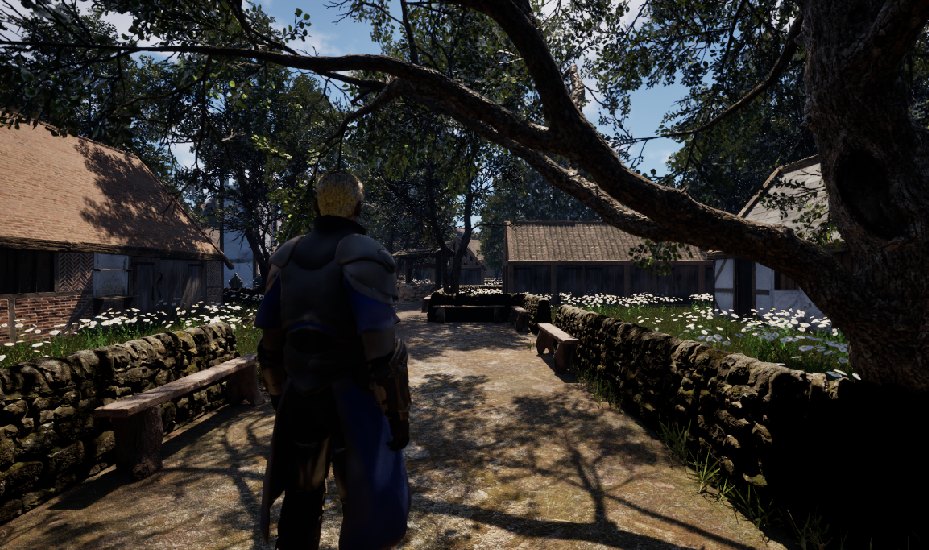
A MetaHuman stand-in character in dark armour stands on a sunlit village path between low dry-stone walls, with wooden benches set against the walls and timber-framed cottages beyond.
The proving ground. A MetaHuman stand-in in a borrowed village; the benches against the walls are the problem this entry is about.

It found things on the first walk. The rubble walls had rounded tops, and the body refused to vault them, because the stone just past the edge was too steep to stand on. A person doesn't need to stand on a wall to vault it, so now the body feels along a rounded top to its crest. Rubble walls, round boulders, and barrels lying on their side can now be gone over.

Then came a wall with a bench against it, and the body refused again. It had judged the bench and the wall as two separate things, neither of them the way over. That one mistake settled a bigger question.

Thessyra is a world players build and break. Nothing in it can be prepared in advance, no hidden marks saying "climb here", because by tomorrow the wall may be rubble and the bench may be firewood. So the body reads what is really there, every time, and it reads it honestly. A bench, a stool, a crate, a barrel, or a hay bale in front of something taller is a step, and the taller thing is measured from the top of it. The same height is always reachable or it isn't, whatever happens to be lying around.

That makes ingenuity part of the game. In the village, round hay bales are stacked against a cottage whose eaves sit well out of reach. A tall, skilled climber can pull up onto the first bale and jump for the roof from there. A shorter one climbs the stack bale by bale, and a halfling may need something to reach the first bale at all. Both get onto the roof. Neither was given a ladder. That same stack now stands in the test room, and the trials check every body size against it.

The same thinking reaches further. A place long forgotten should not be walked into; getting in should be a puzzle, solved by bringing the piece that's missing. And standing on things that float or roll, a barrel in the water or a rowboat, is wanted too.

Movement has also been hardened against a poor connection: a long delay, jitter, and one message in twenty lost on the way. Every trial now runs that way as well, and the ones that failed were fixed. A lost message can no longer swallow a leap or a dodge.

What's standing and what isn't: rounded walls, the hay-stack climb, and the poor-connection fixes are built and tested. The bench against the wall still refuses. Reading the whole way over as footholds and handholds, and chaining a step into a vault, is the next piece of work.

September 28, 2026Movement

Holding On, and Letting Go

Hands on stone, feet on rungs, and a body that knows how to fall. Movement, whole at last.

Ladders and ropes can now be climbed: take hold, go up hand over hand, and pull yourself over the top. A rope that ends above your head can be leapt for and caught in the air. Bare stone is another matter. Every surface has its own difficulty, and only a climber whose skill meets it will find a grip; the rest will find none. Most walls in Thessyra can't be climbed at all unless the world, or whoever built them, says otherwise. A climbable castle wall is a choice, never an accident.

A body can lower itself over an edge and hang there by its hands, edge along it, haul itself up, or let go. Fall past a ledge with a hand reaching for it and it may catch, if you're not falling too fast for the grip to hold. What a practised climber catches, a novice doesn't.

Every landing is now weighed against the body taking it: a soft touch, a hard jolt, a roll that carries the speed away, a stumble, or a collapse that leaves you on the ground a breath too long. Practice changes it. The same holds for force from outside, whether a shove, a heavy blow, or a blast. A steady body only flinches; a lighter or less steady one staggers, is thrown back, or is knocked flat. A blow taken near a ledge sends you over it.

For the fight, a body can now dodge (a sidestep, a backstep, a roll), going farther the better it's trained, and lunge a short step toward a foe, stopping when it reaches them rather than passing through. And it can lean around a corner or over cover, head and shoulders out while the feet stay put: to see, and to be seen.

All of it now answers to a set of trials that run on their own every time anything changes: a body climbing, falling, being struck, and the same again across a distant server and a poor connection. What works today keeps working tomorrow. Movement is now being made ready for a first small circle of players to try; each part of the world will go through the same before the next is begun.

Stand-in motions still. The ladder, the rope, bare stone, and the dodge borrow placeholder animation, some of it rough, until Thessyra's own is made. What's being tested now is how a body moves, not yet how it looks doing it.

September 26, 2026Movement

The Weight of a Body

A new way of building, and a body that finally answers to the one who wears it.

The way Thessyra is built has changed. Rather than one sprawling tangle where every piece leans on every other, the world is now being raised as separate, self-standing parts (how a body moves, how the eye sees, how steel meets flesh), each built and tested on its own, each speaking to the rest only through a small set of agreed rules. Slower at the start. Far sturdier for everything that comes after.

The first part raised this way is movement, and it has been rebuilt from the ground up around one idea: the body belongs to the character. A heavy fighter in full kit gathers speed slowly, stops hard, and turns wide. A light, nimble one is off the mark in a heartbeat and can change direction on a coin. Neither is a setting to be picked. It comes from who the character is, and a wound or a heavy load shows in every stride.

Stance is no longer a switch. There are three depths of crouch between standing and dropping flat, stepped through by hand, and a pace to be chosen from a careful creep to a hard run, with a sprint on top for when it matters. A body won't rise where there's no room to rise, either. Beneath a low beam, it stays low.

And the world can now be read. Walk toward a wall, a fence, a crate, a ledge, and the body judges it for itself: step over it, vault it, hurdle it at a run, pull up onto it, or know it's too tall and simply jump. That judgement works on any stone and timber in the world, not on a few pieces placed just so, which matters for a world where players will one day raise their own walls. The same judgement is shaped by the character, too: what a nimble scout clears easily, a heavily armoured one may not clear at all.

One small decision here says a great deal about the rest. A body can go over a railing into a real drop (a rooftop, a balcony, a cliff edge) if the one moving it chooses to. The drop is always shown before the leap, never a surprise. Whether the landing is a roll and a sprint away or a hard, crumpling fall is a matter of who is falling. That is the escape a thief lives by, and the risk a knight in plate had better respect.

Borrowed motions still, for now. The leaps and pulls use stand-in animation until Thessyra's own is made. Climbing proper, hanging from a ledge, and how a body staggers, catches itself, and lands come next.

July 25, 2026Combat

First Steps, Taken

A blade that can be swung. Ground that can be crossed. The first stage stands on its own two feet.

The first stage of building Thessyra is complete: a longsword that can be drawn and swung, a foe that fights back and knows how to fall, a body that can be staggered before it can be killed. Die, and the world doesn't erase you gently. You drop what you carried, ragdoll to the ground, and rise again wherever the road began. Your weapon waits behind, same as your killer's does, for whoever reaches it first. Small, but the first honest proof of a promise made in the charter.

And before moving further, one thing got pulled forward out of order, on purpose: how a body actually moves through the world. Crouching low. Dropping flat to crawl. Leaning around a corner to look before stepping into it. Hauling yourself over a low wall, up a rope, up a ladder, and, for those who've trained the knack for it, up bare stone with nothing but grip and nerve. Movement is felt in every single moment spent in this world, far more than any one system alone, so it earned the right to be gotten right early rather than patched in later.

Rough still, in places. A climb without its proper animation yet is still a climb, just an honest one, still finding its final shape.

July 24, 2026Design

Laying the First Stone

The charter is written. The road is mapped. Now the real work begins.

Thessyra started as a question: what would it take to build a world where nothing is handed to you, where every skill and every scar is genuinely earned? That question has since become a full design: a low-magic, full-loot, use-driven world with no fixed classes, real physical consequence, and a living ecosystem that doesn't wait for anyone.

The design is settled enough to start building on. The engine is chosen. The road ahead is mapped in four honest stages, starting with the smallest, hardest one: making the game feel right for a single pair of boots before anyone else is invited in.

This journal will grow slowly and honestly, with real entries written as real progress happens, not on a schedule invented to look busy.